Getting an AI application built: from idea to a system that works
 Jesse ScherpenMay 13, 20266-minute read

An AI application is software that uses your business data, takes actions in your systems on its own and uses a language model for the thinking. That's something different from a chatbot that gives general answers. Building one comes down to three choices: which problem you solve, which language model you use and how you check the output.
Online, you read that an AI builder gets you an app in five minutes. For a form or a demo, that's sometimes true. For a system your business runs on every day, it isn't. In this article, you'll read what really goes into an AI application that works: examples, the choice between OpenAI, Claude, Gemini, Mistral and the Grok API, and the trade-off between doing it yourself and outsourcing it.
What is an AI application in practice?
The difference from a standalone AI tool is context. An AI application knows your data, works together with the programs you already use and follows your business rules. Think of a system that reads an incoming quote request, checks it against your inventory and has a draft reply waiting in your inbox.
That takes more than a clever prompt: connections to your systems, a place to store data and a way to keep the whole thing running reliably.
Why ready-made AI builders often fall short
- Little flexibility: it works until you want something the platform can't do. Then you're stuck.
- Unclear where your data goes: many cheap builders send everything unfiltered to outside servers. With customer or financial data, that's an unnecessary risk under the GDPR.
- Dependence: your processes run on someone else's platform, at their prices and on their terms.
For a first test, they're fine. For processes that matter, you want to own your system.
Three examples that do work
1. Processing inquiries automatically
Instead of reading every contact form yourself, you have an AI application assess the inquiry, pull out the company name and the problem, add public data and put it in your CRM. Your salesperson only calls about inquiries that fit. You can see how we make emails and calls land with the right client automatically in our case on CRM processing.
2. Answering customer questions with your own knowledge
A chatbot that sounds like ChatGPT does nothing for you. A system that first searches your own manuals, terms and earlier tickets, and only then answers, does. That technique is called RAG: the language model gets the relevant passages from your documents to work with. Fewer made-up answers, more answers that are right.
3. Custom reports
For businesses that process a lot of data, like inspection companies or marketing agencies, reporting takes a lot of time. An AI application turns raw data, such as inspection notes or numbers from your analytics, into a clear report in your own branding.
Which language model should you choose?
The language model does the thinking for your application. The big providers are close to each other, so choose based on what counts for your use case:
- OpenAI (GPT): broadly usable, with lots of examples and connections available.
- Anthropic (Claude): strong with long documents and careful writing.
- Google (Gemini): handy if you already work with Google Workspace, and strong with images and lots of context at once.
- Mistral: a European provider, worth a look if you want to keep your data in Europe.
- xAI (Grok): see below.
More important than the brand: build it so you can switch later. Models get better and cheaper every few months, and if you're stuck with one provider, you don't benefit from that.
The Grok API: when is it worth a look?
Grok is the language model from xAI, Elon Musk's AI company. Through the API, you use it in your own software. Three things to know:
- Easy to switch to: the API is set up like OpenAI's. Software that already talks to OpenAI can be switched over with few changes.
- Current information: xAI promotes Grok as having access to current posts on X. That can be useful for trend analysis or for following what's being said about your brand.
- The same rules for your data: with Grok too, you don't send along sensitive customer data that doesn't belong there.
For most business processes, like pulling data from emails or sorting inquiries, there's no reason to choose Grok over the other models. If current social media data makes the difference in your use case, it's a serious option.
Connecting a language model without programming
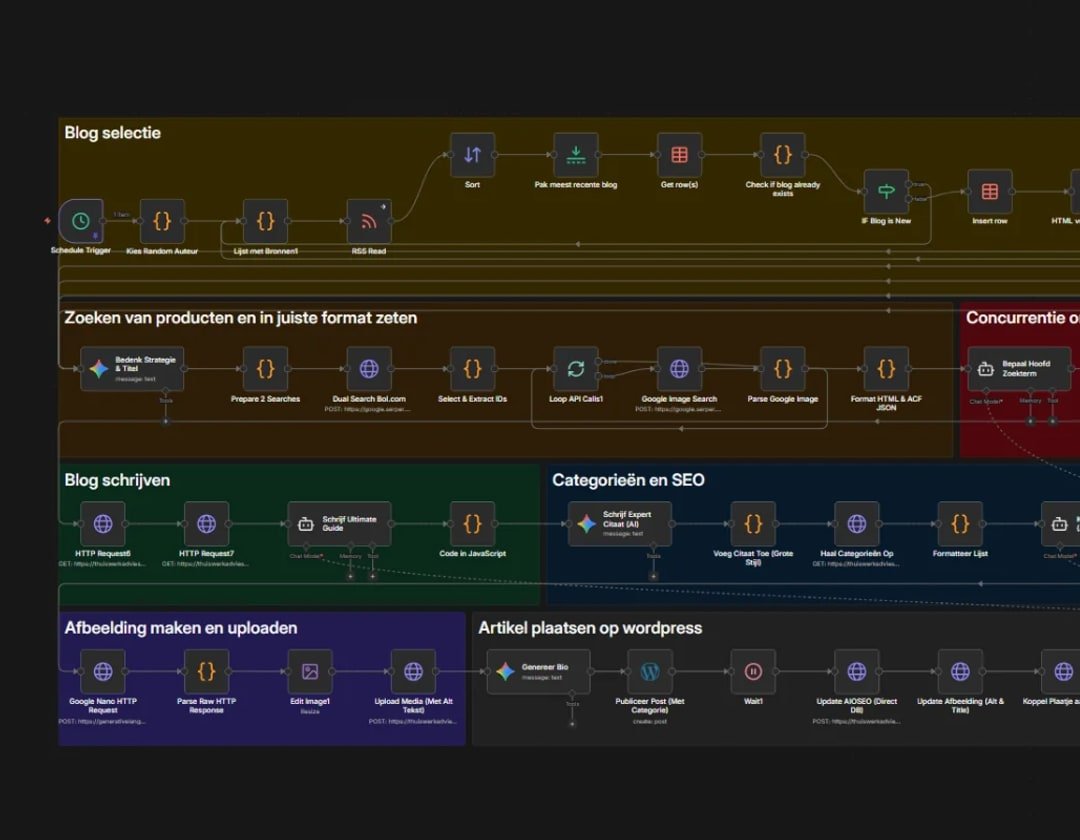
For many processes at small businesses, you don't need to write code. With an automation platform like n8n, you connect a language model to your email, CRM or online store. You can see step by step what happens, and if a provider hiccups, you build in a retry or an alert. Set the "temperature" setting low if you want predictable, structured output, and higher if you're looking for creative variations.
Always check the output
Every language model makes something up now and then, with full confidence. The golden rule: check what comes out before the next step continues with it.
- Do you ask for a fixed format, like a list of fields? Check automatically that all the fields are there and correct.
- Give clear boundaries: what the goal is, what's not allowed and what to do when in doubt. Writing good prompts is not an afterthought.
- Have a person check decisions with consequences, like a quote that goes to a customer.
I don't deliver thick reports or empty promises. I deliver working systems that you stay in control of.
Jesse Scherpen, owner of SharpClicks
Privacy and the GDPR
Never just send raw customer data to an outside provider. Take out names, addresses, BSNs (Dutch citizen service numbers) and IBANs before a text goes to a language model, choose processing in Europe where possible and sign a data processing agreement. Read where it's best to run the parts of your application in our article on hosting AI agents and language models.
Do it yourself or outsource it?
With time and technical skill, you can get a long way on your own. The question is whether that's the best use of your time. Maintaining connections, fine-tuning instructions and fixing what breaks when a provider changes something takes hours, week after week.
- Doing it yourself works for a simple connection that isn't business-critical.
- Outsourcing is smarter if the system has to work every day, handles sensitive data or is connected to multiple programs.
At SharpClicks, we build these kinds of systems for small and mid-sized businesses, from Coevorden in the Netherlands. We look at your process first, then sketch what's needed and then build a system that works. No advisory report that leaves the rest up to you.
Conclusion
Building an AI application isn't a goal in itself. It's a way to get work done that now happens by hand. Start with the problem, choose a language model you can switch away from later, and build in checks from day one.
Have a process in mind? Book an intro call and we'll look together at where the gains are. Read more about what we build under custom software.
Frequently asked questions
What's the difference between an AI chatbot and an AI application?
A chatbot answers questions. An AI application uses your own data, takes actions in your systems, like putting a lead in your CRM, and follows your business rules.
Which language model is best for my business?
That depends on the use case. OpenAI, Claude and Gemini are all strong; Mistral is worth a look if you want to keep your data in Europe. What matters more is that your application is built so you can switch models later.
Can you use the Grok API for business?
Yes. xAI offers an API that's set up like OpenAI's. Grok is mainly interesting if current information from X matters for your use case. For most business processes, other models work just as well.
Do I need programming skills to build an AI application?
Not for simple connections: with an automation platform like n8n, you can get a long way. For applications that have to work every day, with sensitive data or multiple connections, you do need technical knowledge.
How do I keep an AI application from making mistakes?
Check the output automatically before the next step continues with it, give the model clear boundaries and have a person check decisions that have consequences.
 How we can help
AI automation. Work that does itself. One-time build €750 to €2,500.
See the service
Written by Jesse
Jesse Scherpen is the owner of SharpClicks. He studied e-commerce at Windesheim, wrote blogs himself and managed ads for clients, and now builds the systems that take over that work.